Ancient Ingredients. Forgotten Traditions. Modern Alchemy.
A leaf for this London day
THE BOTANICAL OF THE DAY
A new treasure from the natural world, revealed with each passing dawn.
Otto Wilhelm Thomé, Flora von Deutschland (1885). Public domain. Wikimedia Commons.
Image source & rights
The Herbarium
Wild Garlic
Allium ursinum
Known in Britain as ramsons, wild garlic has been valued as spring food for centuries. The RHS records its use during the hungry gap, when stored winter crops were dwindling before the new harvest. Plantlife traces the name ramsons to Old English...
Warm, sweetly aromatic and clove-like, with suggestions of cinnamon and nutmeg and a peppery edge. These comparisons describe its character; t...
Köhler’s Medizinal-Pflanzen, plate 174 (1890), Biodiversity Heritage Library scan via Wikimedia Commons. Public-domain original; scan also offered under CC BY 2.0. Unmodified display. Labelled Pimenta officinalis.
Image source & rights
The Spicer's Cabinet
Allspice
Pimenta dioica
Allspice is one ingredient with a name that sounds like a mixture. PROSEA records the dried fruit in meat cookery, pickling liquids, baking and preserves, as well as the Jamaican drink pimento dram. Its history belongs first to the Caribbean and Central...
Warm, sweetly aromatic and clove-like, with suggestions of cinnamon and nutmeg and a peppery edge. These comparisons describe its character; the fruit contains none of those other spices. Whole fruits releas...
Meat: Pork, beef and lamb offer enough richness to carry a restrained warm-spice accent.
Vegetables & pulses: Squash, carrot, red cabbage and lentils provide sweetness or earthy depth. Taste a little against the food before committing it to the whole dish.
Fruit: Apple, pear and plum give acidity and juiciness beside the dry spice. A small amount preserves the identity of the fruit.
Grains & dairy: Oats, barley, rice, butter and cream provide mild backgrounds. These are contemporary pairing suggestions, not a reconstruction of a particular Caribbean or European recipe.
Cooked barley is gently nutty and earthy, with a satisfying chew and a mild sweetness. Pearled barley is polished and softens more readily; hu...
Otto Wilhelm Thomé, Flora von Deutschland (1885); cleaned by C. S. v. Bibra. Public domain.
Image source & rights
The Ancient Granary
Barley
Hordeum vulgare
Barley belongs to the early agricultural history of the Near East. Harvard's Museum of the Ancient Near East holds barley cakes from Nuzi, in present-day Iraq, dating to around 1400 BCE. They are direct evidence of a stored grain food, distinct from...
Cooked barley is gently nutty and earthy, with a satisfying chew and a mild sweetness. Pearled barley is polished and softens more readily; hulled forms retain more of the outer grain and a firmer character....
Meat & poultry
Beef, lamb, game and chicken suit its substantial texture.
Vegetables & fungi
Mushrooms, leeks, carrot, celeriac and roasted roots echo its earthy notes.
Bilberry combines dark-fruit sweetness with lively acidity and a gently earthy character. The small berries have tender skins and intensely co...
C. A. M. Lindman, Billeder af Nordens Flora (1917 edition), BHL; cleaned by Andreas Plank. Public domain.
Image source & rights
The Berry Chronicles
Bilberry
Vaccinium myrtillus
Bilberry is also known as blaeberry or whortleberry, reflecting regional names for a familiar wild fruit. The Woodland Trust records its culinary use in preserves, tarts and other fruit preparations. Its presence in British habitats and these continuing uses should not be...
Bilberry combines dark-fruit sweetness with lively acidity and a gently earthy character. The small berries have tender skins and intensely coloured flesh and juice. Their tartness can make them feel more co...
Fruit
Apple and pear give a softer, sweeter background.
Dairy
Cream, yoghurt and fresh soft cheese mellow the fruit's acidity.
Dry, pungent warmth with woody, citrus-like and sometimes floral top notes. Freshly crushed peppercorns reveal more aroma than a long-open pac...
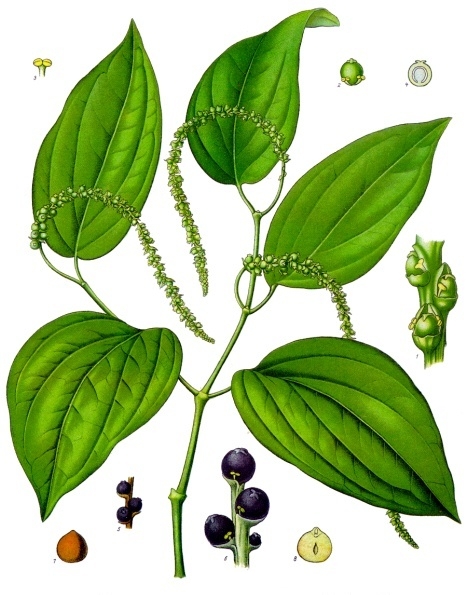
Köhler’s Medizinal-Pflanzen (1897), public-domain botanical plate, via Wikimedia Commons.
Image source & rights
The Spicer's Cabinet
Black Pepper
Piper nigrum
Black pepper’s familiar place beside salt conceals an extraordinary trading past. Oxford University’s Plants 400 account traces the exchange between Asia and Europe into antiquity, including Roman demand for Indian pepper. Its high value later helped support Mediterranean trading centres and European...
Dry, pungent warmth with woody, citrus-like and sometimes floral top notes. Freshly crushed peppercorns reveal more aroma than a long-open packet of powder. Origin, freshness and processing affect the balanc...
Vegetables: Mushrooms, potatoes and roasted roots carry pepper’s woody warmth.
Meat & poultry: Beef, pork and chicken provide a rich background for a fresh aromatic finish.
Grains & pulses: Barley, lentils and white beans suit a measured peppery accent.
Fruit & dairy: Pear, strawberries, butter and cheese offer sweet or creamy contrasts. These are contemporary flavour suggestions.
Pot marigold sits between the ornamental border and the kitchen garden. The nineteenth-century Köhler plate reproduced here records the same Calendula officinalis grown for edible petals today. The RHS records the culinary nickname “poor man’s saffron”, reflecting the petals’ ability to colour...
Petals bring a lightly peppery, faintly bitter accent, with colour often more noticeable than perfume. Fresh petals are soft and delicate; dried petals are papery. The whole flower centre and green base are ...
Grains: Rice and barley offer a mild background for the golden petals.
Eggs: Eggs carry the colour and a gentle peppery accent.
Vegetables: Leafy salads, peas and vegetable soups suit a small scattering of petals.
Dairy: Butter and soft cheese provide richness beside the mild bitterness.
Aromatic and peppery, with a dry woody, slightly camphor-like character and noticeable bitterness. The perfume can be more striking than simpl...
Köhler’s Medizinal-Pflanzen (1897), public-domain botanical plate, via Wikimedia Commons.
Image source & rights
The Spicer's Cabinet
Cubeb
Piper cubeba
Cubeb is a pepper with a visible tail: each small dried fruit retains a slender stalk. PROSEA records its use as a European spice from the Middle Ages onwards, followed by a period when medicinal demand became more prominent. That changing market...
Aromatic and peppery, with a dry woody, slightly camphor-like character and noticeable bitterness. The perfume can be more striking than simple heat. Use a small amount first: cubeb does not reproduce black ...
Meat: Rich lamb or beef provides a substantial background for its dry aromatic character.
Vegetables: Mushrooms and roasted roots can carry a restrained woody accent.
Fruit: Pear and citrus give sweet or bright contrasts to the bitter finish.
Grains & pulses: Rice, barley and lentils provide mild foundations for exploring a small quantity. These are contemporary suggestions.
Briny and savoury, with a rounded marine aroma. Dried fronds can be leathery or crisp depending on preparation; flakes distribute the flavour ...
Pierre-Louis and Hippolyte-Marie Crouan, Alguier (1852), Université de Bourgogne. Public domain. Labelled Rhodymenia palmata, an older name for Palmaria palmata.
Image source & rights
The Mariner's Herbarium
Dulse
Palmaria palmata
Dulse belongs to a coastal larder that crosses the Atlantic. The Marine Biological Association’s MarLIN review records food use in North America and in Brittany, Ireland and Iceland, including dried fronds used as a condiment. The Crouan brothers preserved and documented Palmaria...
Briny and savoury, with a rounded marine aroma. Dried fronds can be leathery or crisp depending on preparation; flakes distribute the flavour more gently than a large piece. Its natural salinity can reduce t...
Vegetables: Potatoes, leeks and roasted roots give the marine flavour an earthy background.
Eggs & dairy: Eggs, butter and mild cheese soften its salinity.
Grains & pulses: Barley, rice and lentils welcome a savoury accent.
Fish: Mild fish can carry dulse without a heavy sauce or many competing spices.
Fresh ginger is pungent, warming and aromatic, with citrus-like freshness and fibrous flesh. Dried ground ginger is less juicy and more warmly...
Köhler’s Medizinal-Pflanzen (1883–1914); cleaned by RaboKarbakian. Public domain.
Image source & rights
The Root Cellar
Ginger
Zingiber officinale
Kew describes ginger as one of the early Asian spices to reach Europe through Arab traders and records its use in Asian cuisine since antiquity. These trade connections predate the modern global pantry. Ginger therefore belongs to several culinary histories, not exclusively...
Fresh ginger is pungent, warming and aromatic, with citrus-like freshness and fibrous flesh. Dried ground ginger is less juicy and more warmly earthy. Neither has the same balance as sweet preserved ginger, ...
Meat & poultry
Pork, chicken and duck can carry ginger's aromatic heat.
Kew identifies south-western India as cardamom's native home and records trade within India over at least a thousand years. Its history belongs to South Asian plant knowledge and exchange, not simply to a European medieval pantry. The aromatic seeds remain an important...
Green cardamom is intensely fragrant: citrus-like, floral and cooling, with a resinous edge and warm spice underneath. The small dark seeds carry the flavour; the green capsule protects them. Its perfume can...
Meat & poultry
Chicken and lamb can carry its warm, fragrant intensity.
Fruit
Pear, apple, orange and stone fruit welcome its citrus-floral lift.
Sweetly nutty and gently earthy, with a rounded richness. Roasting brings a deeper toasted character, while the thin brown skin can add bitter...
Otto Wilhelm Thomé, Flora von Deutschland (1885), public domain.
Image source & rights
The Woodland Larder
Hazelnut
Corylus avellana
Hazelnuts connect the kitchen with a long tradition of managed woodland. The Woodland Trust records large-scale British nut growing into the early twentieth century, with cultivated cobnuts surviving particularly in Kent. The tree also supplied flexible coppice wood for hurdles and other...
Sweetly nutty and gently earthy, with a rounded richness. Roasting brings a deeper toasted character, while the thin brown skin can add bitterness. Fresh cobnuts have a greener, milder flavour than fully dri...
Chocolate & fruit: Dark chocolate, pears and apples balance the nut’s sweetness with bitterness or acidity.
Vegetables: Mushrooms, squash and roasted roots welcome a crisp, toasted contrast.
Dairy: Yoghurt, soft cheese and butter echo the kernel’s richness.
Grains: Oats, barley and bread gain a nutty aroma and contrasting crunch.
A sharp, clean, nose-tingling pungency rather than chilli-like warmth. Freshly grated root is especially forceful; its character fades after p...
Christiaan Sepp, in Jan Kops, Flora Batava, volume 4 (1822). Public-domain plate, digitised via www.BioLib.de / Kurt Stueber. Labelled Cochlearia armoracia, a synonym of Armoracia rusticana.
Image source & rights
The Root Cellar
Horseradish
Armoracia rusticana
Horseradish’s old botanical name, Cochlearia armoracia, appears in the 1822 Flora Batava plate reproduced here. Kew recognises Armoracia rusticana as the accepted modern name. The plant’s kitchen identity is unusually direct: a pale root is grated to release a vivid condiment. The...
A sharp, clean, nose-tingling pungency rather than chilli-like warmth. Freshly grated root is especially forceful; its character fades after preparation and much of the flavour is lost in cooking. The flesh ...
Meat: Beef provides a rich background for its sharp pungency.
Vegetables: Beetroot, potatoes and cabbage offer sweet or earthy contrasts.
Fish: Oily or smoked fish can carry a small amount of sharp root flavour.
Dairy & eggs: Cream, yoghurt and eggs soften the immediate bite.
Resinous and pine-like, with a dry woody edge, a little bitterness and a fresh, almost citrus-like lift when crushed. Its distinctive perfume ...
Otto Wilhelm Thomé, Flora von Deutschland, Österreich und der Schweiz (1885), public domain, via Wikimedia Commons. Unmodified display.
Image source & rights
The Berry Chronicles
Juniper
Juniperus communis
Juniper connects woodland flavour with the history of drinks and meat cookery. Oxford’s Plants 400 account records the cones as a flavouring for game and gin, and places Hogarth’s Gin Lane in the debate surrounding the Gin Act of 1751. The print...
Resinous and pine-like, with a dry woody edge, a little bitterness and a fresh, almost citrus-like lift when crushed. Its distinctive perfume is often more important than heat. A few fragments can remain not...
Meat: Pork, venison and duck offer richness against juniper’s dry aromatic edge. Use it as an accent so the food remains recognisable.
Vegetables: Red cabbage, beetroot, mushrooms and roasted roots give sweet or earthy contrasts. A creamy or buttery accompaniment can soften the impression of bitterness.
Grains & pulses: Barley, lentils and white beans provide quiet backgrounds for comparing a little crushed juniper with milder herbs.
Fruit: Apple, pear and dark berries offer a sweet-acid counterpoint. These are contemporary flavour suggestions; they are not claims that every combination belongs to one historical cuisine.
Peppery warmth with an aromatic, slightly sweet and woody character. Its profile is rounder and more complex than a simple burst of chilli hea...
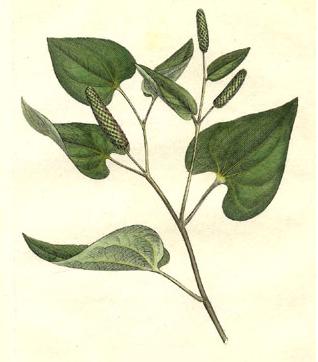
William Woodville, Medical Botany (1793), cropped historical print. Public domain.
Image source & rights
The Spicer's Cabinet
Long Pepper
Piper longum
Before pepper meant only familiar round peppercorns, long pepper had a place in Mediterranean trade. PROSEA describes its high standing in Pliny’s Rome, where it was valued more highly than black pepper. Its unusual shape comes from numerous small fruits arranged together...
Peppery warmth with an aromatic, slightly sweet and woody character. Its profile is rounder and more complex than a simple burst of chilli heat. Intensity varies with the spice’s freshness and species, so co...
Meat: Beef, lamb and pork offer richness against its sustained warmth.
Vegetables: Mushrooms, roasted roots and squash carry woody spice well.
Fruit: Pears, apples and darker berries provide a sweet-acid counterpoint.
Grains & dairy: Barley, lentils, butter and cream soften its peppery finish.
Lovage bridges the herb garden and the vegetable patch: one tall perennial supplies leaves, stems and aromatic seeds. Nineteenth-century herbals depicted the same species that gardeners cultivate today. The RHS records leaves as the principal kitchen harvest, with stems used in a...
An emphatic celery-like taste with green parsley notes, a little sweetness and a hint of anise. Young leaves are more agreeable than older foliage, which becomes bitter as flowering develops. A small amount ...
Potatoes & roots: Mild potatoes, carrots and roasted roots offer a sweet, earthy background.
Eggs & dairy: Eggs, butter and soft cheese soften the herb’s assertive green character.
Pulses: Lentils and white beans welcome a leafy, savoury accent.
Poultry & vegetables: Chicken, peas and vegetable broths benefit from a clear celery-like note.
A powerful resinous perfume with pine-like freshness, a faint woody sweetness and a lingering, slightly bitter finish. Tiny quantities can dom...
Köhler’s Medizinal-Pflanzen (1897), public domain. This plate depicts the source shrub; the culinary ingredient is its food-grade resin.
Image source & rights
The Forgotten Pantry
Mastic
Pistacia lentiscus
Mastic belongs to the pantry as a resin rather than a leaf, seed or fruit. On Chios, families maintain a demanding annual cycle of tending shrubs, preparing the ground and collecting the solidified resin tears. UNESCO recognised this communal cultivation knowledge in...
A powerful resinous perfume with pine-like freshness, a faint woody sweetness and a lingering, slightly bitter finish. Tiny quantities can dominate a mild food, so think of it as an aromatic accent rather th...
Milk & cream: Mild dairy provides a clear background for the resinous aroma.
Bread & grains: Enriched bread and rice-based sweets can carry its perfume.
Nuts: Almond and pistachio offer gentle richness alongside the pine-like note.
Fruit: Citrus zest offers an aromatic bridge; use restraint so neither element overwhelms.
Pyropia, Porphyra and related culinary red algae; names vary by species and taxonomic treatment
Dried, toasted nori is crisp and papery, with a marine aroma, gentle saltiness and a roasted, savoury finish. Moisture quickly changes its tex...
Crouan brothers, Algues marines du Finistère (1852), public domain. Porphyra purpurea is one laver species, not a universal nori identification plate.
Image source & rights
The Mariner's Herbarium
Nori / Laver
Pyropia, Porphyra and related culinary red algae; names vary by species and taxonomic treatment
Nori and laver are culinary names, not a single botanical species. FAO's Porphyra profile documents cultivation in Japan, Korea and China from the seventeenth century. Kathleen Drew-Baker's 1949 work on the microscopic life stage helped make dependable cultivation possible. This is a...
Dried, toasted nori is crisp and papery, with a marine aroma, gentle saltiness and a roasted, savoury finish. Moisture quickly changes its texture to soft and pliable. Prepared laver can be quite different i...
Fish & seafood
Fish, prawns and shellfish echo its coastal character.
Vegetables
Potatoes, mushrooms, cucumber and spring vegetables contrast with its marine umami.
Deeply savoury, earthy and nutty, with a firm, meaty texture when cooked. Dried porcini has a more concentrated woodland aroma than fresh mush...
James Sowerby, Coloured Figures of English Fungi or Mushrooms, plate 111 (1797), public domain; scan cleaned by Natr.
Image source & rights
The Fungarium
Porcini — Penny Bun
Boletus edulis
Penny bun, cep and porcini are different kitchen names around the same celebrated woodland mushroom. The Woodland Trust records the Italian name as “little pigs” and notes its importance as a dried flavouring. James Sowerby illustrated Boletus edulis in 1797, placing it...
Deeply savoury, earthy and nutty, with a firm, meaty texture when cooked. Dried porcini has a more concentrated woodland aroma than fresh mushrooms and can become the dominant flavour even in a modest amount.
Grains: Barley, rice and bread provide a mild, absorbent background for the savoury aroma.
Meat: Beef, chicken and pork echo its rich character.
Vegetables: Onion, squash and other mushrooms bring sweetness or woodland depth.
Dairy: Butter, cream and mature cheese round the earthy finish.
Fragrant rose petals offer floral perfume and a soft texture, sometimes with slight bitterness at the pale petal base. Flavour differs greatly...
Henri Joseph Redouté, Les Roses: Rosa Damascena, subalba (1817–1824). Cleveland Museum of Art, 1965.291, Mr and Mrs Charles G. Prasse Collection. CC0.
Image source & rights
The Floral Codex
Rose Petals
Rosa species and cultivars sold for culinary use
Roses have a long cultural life, but fragrance, perfumery and food are not interchangeable evidence. The RHS documents culinary petals in drinks, sugar and confectionery. Rosewater vessels in museum collections also show the wider cultural importance of rose fragrance; a vessel alone...
Fragrant rose petals offer floral perfume and a soft texture, sometimes with slight bitterness at the pale petal base. Flavour differs greatly between cultivars. Food-grade rosewater is more concentrated and...
Fruit
Strawberries, raspberries, peaches and citrus welcome a floral accent.
Strongly aromatic, resinous and pine-like, with a woody, slightly bitter edge. Finely chopped young leaves are more comfortable to eat than to...
Otto Wilhelm Thomé, Flora von Deutschland (1885), public domain. Labelled with the older synonym Rosmarinus officinalis.
Image source & rights
The Herbarium
Rosemary
Salvia rosmarinus
Rosemary carries both kitchen history and a rich symbolic life. The RHS traces its introduction to Britain to the Romans, while its Lindley Library describes early printed herbals that associated it with memory. Those historical beliefs are cultural evidence, not health advice....
Strongly aromatic, resinous and pine-like, with a woody, slightly bitter edge. Finely chopped young leaves are more comfortable to eat than tough needles; prolonged cooking can release a forceful aroma.
Meat: Lamb and pork have enough richness to stand beside the herb’s resinous character.
Vegetables: Potatoes, squash and roasted onions offer sweetness and a soft centre.
Pulses & bread: White beans and bread carry a measured rosemary aroma.
Fruit: Apple, pear and a little citrus offer a sweet or bright counterpoint.
Sage has moved between the herbalist’s book and the cook’s garden for centuries. The RHS notes the old association of its name with healing, but also its familiar British culinary place in turkey stuffing. This leaf keeps those histories separate: an old...
Warm, earthy and slightly camphor-like, with a dry savoury finish and a little bitterness. The soft-looking leaf has a felted surface but a substantial texture. Dried sage is concentrated and can quickly bec...
Meat & poultry: Pork, chicken and turkey provide richness beside the earthy leaf.
Vegetables: Onion, squash and potatoes welcome a warm herbal accent.
Dairy: Butter and mature cheese soften the bitter edge.
Grains & pulses: Bread, barley and white beans give sage a mild background.
Shiitake's cultivated history belongs to China and Japan. FAO describes its early log-growing tradition in China and recognises Qingyuan's forest–mushroom system as agricultural heritage. Kew also holds the type material collected on the nineteenth-century Challenger Expedition. That scientific collection is distinct from...
Shiitake has a deep savoury character, a woodland aroma and a firm, pleasantly chewy cap when cooked. Dried shiitake is more concentrated and earthy than the fresh mushroom. Its assertive umami can lend dept...
Meat & poultry
Chicken and pork complement its savoury depth.
Vegetables
Spring onions, cabbage, roasted squash and other vegetables gain a contrasting woodland note.
Gently nutty, earthy and slightly sweet. Cooked whole grains retain a pleasing chew; pearled products soften more readily. Flour gives a diffe...
Nikolaus Thomas Host, Icones et descriptiones Graminum austriacorum (1801–1809), via Biodiversity Heritage Library. Public domain.
Image source & rights
The Ancient Granary
Spelt
Triticum aestivum subsp. spelta
Spelt’s ancient reputation is best anchored in particular places rather than in vague claims of timelessness. English Heritage includes it among the crops grown in Bronze Age Britain. Kew’s account of wheat describes European spelt and cautions against casually calling it a...
Gently nutty, earthy and slightly sweet. Cooked whole grains retain a pleasing chew; pearled products soften more readily. Flour gives a different culinary experience from an intact grain, so the two should ...
Vegetables: Mushrooms, leeks, squash and roasted roots echo its earthy character.
Pulses: Lentils, peas and broad beans add contrasting softness and green flavour.
Dairy: Butter, yoghurt and mature cheese round the nutty finish.
Fruit & nuts: Apples, pears, hazelnuts and walnuts offer sweet or toasted contrasts.
Earthy and gently peppery, with a warm, slightly sweet herbal aroma. Fresh young shoots are softer and brighter than the woody older stems. Dr...
Köhler’s Medizinal-Pflanzen (nineteenth century), public domain.
Image source & rights
The Herbarium
Thyme
Thymus vulgaris
Thyme’s enduring place in the kitchen runs from the herb garden to the tied bundle of aromatics. The RHS records it as a Roman introduction to Britain and identifies common thyme as an ingredient of bouquet garni and herbes de Provence. These...
Earthy and gently peppery, with a warm, slightly sweet herbal aroma. Fresh young shoots are softer and brighter than the woody older stems. Dried thyme remains assertive and is easily used too heavily in del...
Vegetables: Mushrooms, tomatoes, onions and roasted roots give the earthy flavour a natural setting.
Poultry: Chicken and turkey carry the aroma without needing a dense mixture of herbs.
Pulses: Lentils and white beans welcome a dry herbal accent.
Dairy & grains: Butter, cheese, bread and barley soften the peppery edge.
Fresh leaves have a green, unmistakably garlic-like aroma, with softer pungency than a raw garlic clove. Their tender texture suits delicate f...
Otto Wilhelm Thomé, Flora von Deutschland (1885). Public domain. Wikimedia Commons.
Image source & rights
The Herbarium
Wild Garlic
Allium ursinum
Known in Britain as ramsons, wild garlic has been valued as spring food for centuries. The RHS records its use during the hungry gap, when stored winter crops were dwindling before the new harvest. Plantlife traces the name ramsons to Old English...
Fresh leaves have a green, unmistakably garlic-like aroma, with softer pungency than a raw garlic clove. Their tender texture suits delicate foods; heat softens the flavour. The flowers bring an aromatic, on...
Meat & poultry: Chicken and mild poultry give the leafy garlic aroma space to emerge.
Fish: White fish welcomes a green allium accent without needing heavy spice.
Vegetables: Potatoes, mushrooms, peas, asparagus and other spring vegetables offer earthy or sweet contrasts.
Eggs & dairy: Eggs, butter, soft cheeses and mature cheese balance the herb's pungency with richness.