
The Floral Codex
I. The Ingredient
II. Origins & History
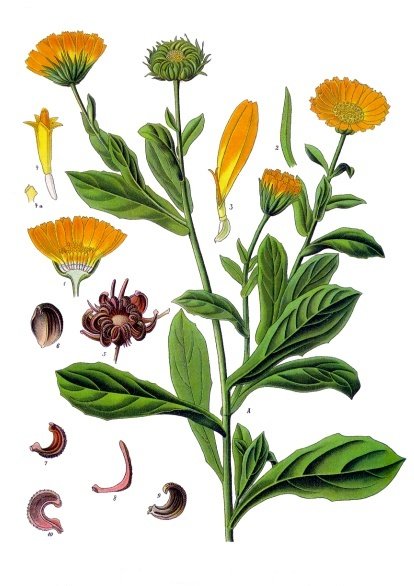
Pot marigold sits between the ornamental border and the kitchen garden. The nineteenth-century Köhler plate reproduced here records the same Calendula officinalis grown for edible petals today. The RHS records the culinary nickname “poor man’s saffron”, reflecting the petals’ ability to colour food. Calendula is not botanical saffron and does not reproduce saffron’s distinctive flavour; the comparison is principally one of colour and kitchen economy. Its peppery petals can accompany both savoury and sweet food, while the pairings below are contemporary suggestions.
III. The Flavour
Petals bring a lightly peppery, faintly bitter accent, with colour often more noticeable than perfume. Fresh petals are soft and delicate; dried petals are papery. The whole flower centre and green base are not treated as interchangeable with the petals in this leaf.
- Aroma
- Mildly herbal rather than strongly perfumed
- Texture
- Soft fresh petals; papery when dried
- Intensity
- Mildly peppery and slightly bitter
IV. Culinary Affinities
Contemporary flavour suggestions, distinguished from documented historical combinations.
Grains: Rice and barley offer a mild background for the golden petals.
Eggs: Eggs carry the colour and a gentle peppery accent.
Vegetables: Leafy salads, peas and vegetable soups suit a small scattering of petals.
Dairy: Butter and soft cheese provide richness beside the mild bitterness.
V. Companions in the Mortar
Chives, parsley and thyme keep the character savoury. Coriander seed adds a brighter aromatic note. Let the petals provide colour without burying them beneath a heavy spice blend.
VI. The Alchemist’s Note
Use a small quantity of petals as an accent rather than expecting the flavour of saffron. Choose fresh or dried Calendula officinalis sold for culinary use.
VII. Sources & Further Reading
- Kew POWO — Calendula officinalis; accepted identity, Asteraceae and current native range
- RHS — Calendula; edible petals and flavour
- RHS — Edible flowers; pot marigold and culinary colour
- Köhler’s Medizinal-Pflanzen — Historical plate, 1897
Reviewed October 2026. Historical imagery is not an identification guide.
Folio 5 · The Grimoire